



Why This Comparison Matters
Thinking of starting a business in Dubai? You’re not alone. Entrepreneurs from around the world flock to the UAE because of its reputation as a global hub for trade, innovation, and investment. But before you get excited about office locations, bank accounts, or employee hiring, there’s one critical decision you need to make: choosing the right company structure.
In Dubai, the legal framework offers three main choices: Mainland, Free Zone, and Offshore. Each comes with unique rules, benefits, and restrictions. And while free zones are often in the spotlight, many investors find themselves torn between two options: Dubai Mainland vs Offshore companies.
This comparison matters because your decision will shape almost everything that follows- from where you can trade, how much tax you pay, whether you can hire employees, and even how clients perceive your credibility.
Here’s a quick thought experiment:
- Imagine you’re planning to open a retail shop in Dubai Mall. Would an offshore company work for you? Absolutely not, you’d need a mainland license.
- Now imagine you’re an Indian investor wanting to hold property in Dubai and enjoy international tax benefits. Does a mainland license make sense? Probably not, you’d be better off with an offshore structure.
See the difference? Same city, two very different journeys.
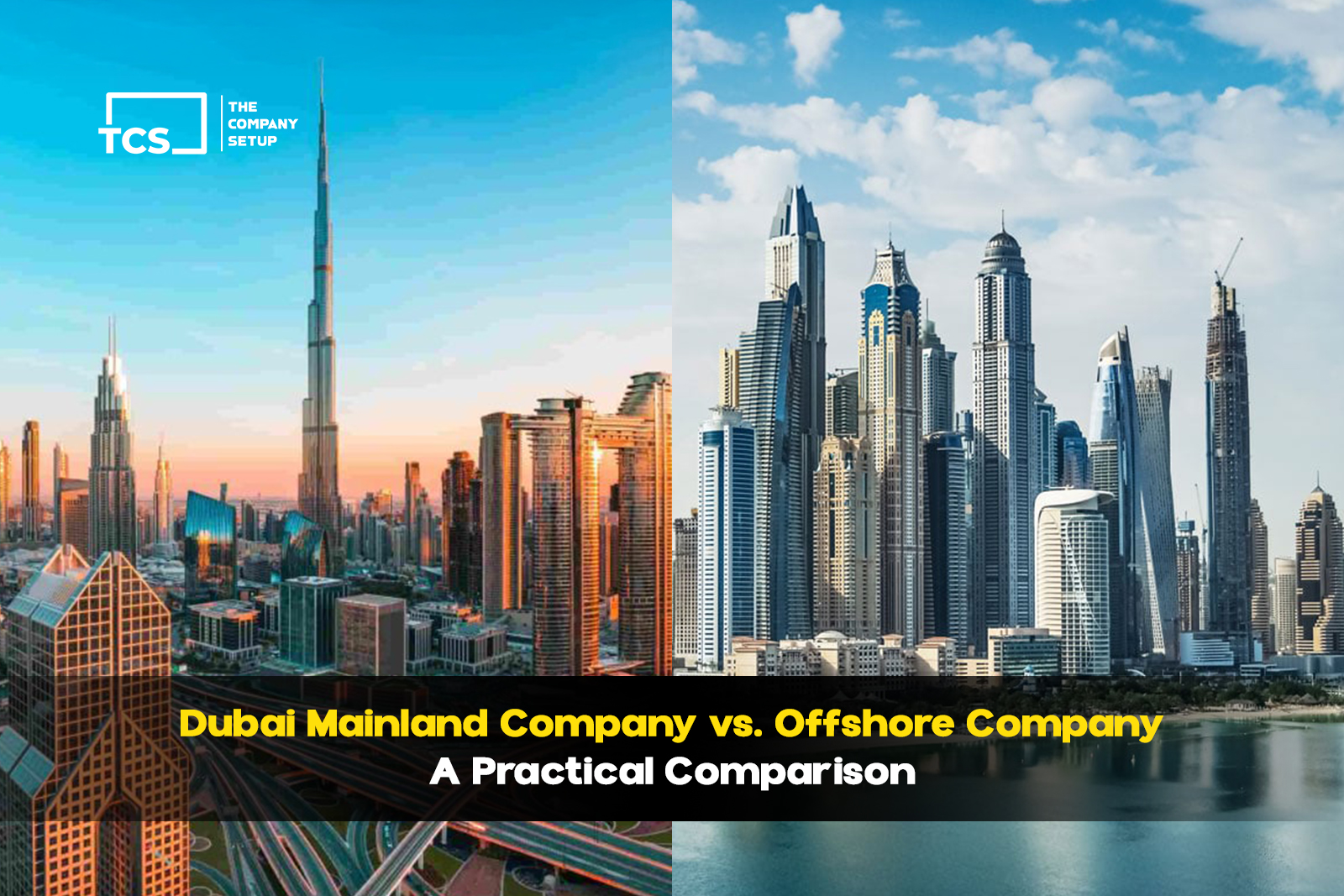
This blog is your practical comparison guide. We’ll break down the differences between mainland and offshore companies in Dubai, ownership rules, visa eligibility, tax implications, setup requirements, and real-world scenarios to help you make the right choice.
Understanding Dubai’s Company Types
Before we zoom into the mainland vs offshore debate, let’s set the stage with a simple breakdown of company types in Dubai.
1. Mainland Companies (Onshore)
- Registered under the Dubai Department of Economy and Tourism (DET).
- Can operate anywhere in the UAE and internationally.
- Post-2021 reforms allow 100% foreign ownership in most activities.
- Suitable for businesses looking to trade directly in Dubai, open offices, hire staff, or bid for government contracts.
Think of it as Dubai’s “main marketplace.” You’re fully part of the local economy.
2. Free Zone Companies
- Registered in designated free zones (DMCC, DIFC, JAFZA, etc.).
- Benefits include 100% ownership, tax advantages, and simplified setup.
- But limited to operating within the free zone or internationally, direct UAE trade requires a distributor.
This is like renting a premium booth in a specialised marketplace.
3. Offshore Companies
- Registered in offshore jurisdictions such as JAFZA, RAKICC, or Ajman Offshore.
- Cannot do business inside the UAE.
- Designed for asset protection, international trade, tax planning, and confidentiality.
- Popular among investors who want a Dubai address for global operations without needing a physical presence in the city.
This is like having a “safe vault” in Dubai- global in reach, local in presence.
Dubai Mainland Company Explained
A Dubai Mainland company gives you the maximum freedom to operate within the UAE economy. Here’s what makes it stand out:
- Unlimited trading rights: You can do business across Dubai, Abu Dhabi, and all Emirates.
- Government contracts: Eligible to work with public sector and semi-government entities.
- Office requirement: Must lease office space in Dubai.
- Visa eligibility: Companies can sponsor employee visas, with capacity depending on office size.
- Ownership rules: Since 2021, many activities allow 100% foreign ownership (except strategic sectors like oil, defense, etc.).
- Reputation: Seen as the most credible business structure for investors and clients.
Best for: Retail, construction, consultancy, import-export, hospitality, healthcare, and any business needing direct local operations.
Dubai Offshore Company Explained
An offshore company in Dubai works very differently. It’s not about opening a shop or hiring employees — it’s about creating a flexible vehicle for global operations.
Key features include:
- No local business rights: Offshore companies cannot trade within Dubai or the wider UAE.
- Asset holding: Popular among foreign investors to hold Dubai real estate.
- Confidentiality: Ownership details remain private.
- Tax efficiency: Offshore entities enjoy global tax benefits and are not subject to UAE corporate tax (as they don’t operate locally).
- No office space required: Registered office address provided by the jurisdiction.
- Visa restrictions: Offshore companies cannot sponsor employee visas (except limited director visas).
Best for: Investors holding assets, HNIs securing Dubai properties, international traders, and companies seeking tax planning benefits.
Mainland vs Offshore – A Head-to-Head Comparison
Now let’s compare Dubai Mainland vs Offshore companies across key parameters:
1. Scope of Operations
- Mainland: Operate freely across the UAE and internationally.
- Offshore: Operate only internationally; no local UAE trade allowed.
2. Ownership & Control
- Mainland: 100% foreign ownership in most sectors.
- Offshore: 100% ownership always.
3. Tax Implications
- Mainland: Subject to UAE corporate tax (9%) if income exceeds AED 375,000.
- Offshore: No corporate tax (since no local operations).
4. Visa Eligibility
- Mainland: Can sponsor employee visas.
- Offshore: Generally no visa eligibility (except directors).
5. Banking & Compliance
- Mainland: Full access to banking, but stricter compliance (VAT, audits, ESR).
- Offshore: Limited banking options, but simpler compliance.
6. Licensing & Setup
- Mainland license issued by DET.
- Offshore license issued by offshore jurisdiction (JAFZA, RAKICC, etc.).
7. Reputation & Credibility
- Mainland: High credibility for trading and partnerships.
- Offshore: Strong for asset holding, but limited operational reputation.
Practical Scenarios- Which One Should You Choose?
Let’s make this comparison practical.
- Scenario 1: Retail business in Dubai → Mainland (offshore not allowed).
- Scenario 2: Indian HNI buying Dubai property → Offshore (asset holding).
- Scenario 3: Consultancy firm with UAE clients → Mainland (need local presence).
- Scenario 4: Global e-commerce company shipping worldwide → Offshore.
- Scenario 5: Contractor bidding for government projects → Mainland.
In short:
- Choose Mainland if you want to operate in Dubai/UAE.
- Choose Offshore if your business is global and you need asset protection or tax planning.
Dubai Jurisdiction Comparison- Mainland, Free Zone, Offshore
Here’s how mainland, freezone, and offshore stack up:
| Feature | Mainland | Free Zone | Offshore |
| Market Reach | UAE + International | Free Zone + International | International only |
| Ownership | 100% (most activities) | 100% | 100% |
| Tax | 9% Corporate Tax | 9% Corporate Tax (with exemptions) | None |
| Office Requirement | Yes | Yes (flexi-desk possible) | No |
| Visa Eligibility | Yes | Yes | No |
| Reputation | Very High | High | Limited |
Key Decision Factors- How to Choose
When comparing Dubai Mainland vs Offshore company setup, ask yourself:
- Do I need to trade inside Dubai or just operate globally?
- Do I want to hire employees and sponsor visas?
- Am I looking for asset protection and confidentiality?
- How important is tax efficiency vs credibility?
- Do I want to hold property in Dubai through my company?
Your answers will guide you toward the mainland or offshore.
Future Trends in Dubai Company Types
The UAE’s business landscape is evolving:
- Corporate tax introduced in 2023–24 changes how mainland and free zone companies plan profits.
- UBO & ESR regulations increase transparency, especially for offshore companies.
- Digital-first compliance (VAT e-filing, AML monitoring) means smoother processes but stricter checks.
- Offshore structures are increasingly used for property ownership and global wealth planning, while mainland companies remain the backbone of Dubai’s local economy.
Mainland vs Offshore – The Final Word
So, which one should you choose?
- If you want to actively operate in Dubai, trade locally, hire people, and build credibility → Go Mainland.
- If your goal is global trade, tax optimisation, or holding Dubai assets → Offshore is your best bet.
At the end of the day, there’s no “better or worse” — only what’s right for your vision.
Your business is unique. Your structure should be too.
FAQs
1. What is the difference between a Dubai mainland company and an offshore company?
Mainland companies can operate inside the UAE, while offshore companies cannot. Offshore is for global trade and asset holding.
2. Can a Dubai offshore company own property?
Yes, offshore companies (JAFZA, RAKICC) can hold approved properties in Dubai.
3. Do offshore companies in Dubai pay tax?
No, they don’t, since they cannot operate in the UAE market.
4. Can offshore companies hire employees?
No, offshore companies cannot sponsor employee visas.
5. What are the ownership rules in mainland vs offshore companies?
Both allow 100% ownership (post-2021 reforms for mainland).
6. Is a mainland license better than offshore license?
Depends on goals: mainland for local trade, offshore for asset holding.
7. Which is cheaper: mainland or offshore setup?
Offshore is typically cheaper but limited in scope. Mainland gives wider operations.
8. Can offshore companies trade in the UAE market?
No, they can only trade internationally.
9. What are the advantages of mainland business setup in Dubai?
Unlimited market reach, credibility, visa eligibility, government contracts.10. Which is better for international investors: mainland or offshore?
International investors often prefer offshore for holding assets, but mainland if planning UAE expansion.