


Setting up a business in Dubai is one of those decisions that feels equal parts exciting and intimidating. Exciting because Dubai is a global marketplace with serious momentum. Intimidating because the rules, licenses, approvals, and terminology can sound like a different language when you’re new to it. And when you start exploring the Mainland setup, one question almost always comes up on Day 1.
Do you need a local sponsor in Dubai?
This isn’t just a “random Google query.” It’s a real concern because investors often assume that “sponsor” automatically means giving away control, profit, or ownership. Some people hear scary stories. Some hear outdated advice. And others get stuck because one consultant says “yes,” another says “no,” and the entrepreneur in the middle is left confused.
The truth in 2026 is more straightforward than it appears if you understand one key concept: the need for a local sponsor depends on your business activity and license type, not just on the fact that you are opening in the Mainland. In many cases, you can have 100% ownership. In other cases, you still need a sponsor structure. And sometimes you don’t need a sponsor at all, but you must appoint a Local Service Agent (LSA).
This guide explains the entire picture. What a local sponsor in Dubai actually is, when you still need one, how agreements typically work, what people mean by local sponsor fees in Dubai, and how to choose a sponsor safely without making a mistake you regret later.
Mainland Setup in Dubai: What It Really Means
Before we talk about sponsorship, it helps to understand why the Mainland setup is so popular. Dubai company formation generally happens under three broad jurisdictions: Mainland, Free Zone, and Offshore. The Mainland is often preferred by business owners who want maximum flexibility inside the UAE market.
When you set up a Mainland company, you typically gain the ability to operate across Dubai and the UAE without being limited to a specific Free Zone boundary. You can sell to UAE customers directly, sign contracts with local companies, lease offices where it suits you, and generally position yourself as a “local market-ready” business.
For many entrepreneurs, a Mainland setup is the structure that supports long-term growth goals like scaling a team, bidding for bigger corporate opportunities, entering retail, or offering services directly to the public market. It’s also the jurisdiction that tends to feel “most real” for businesses that want to build deep roots in the UAE economy.
Historically, the Mainland came with one major condition: local participation. That’s where the concept of sponsorship entered the picture.
What Is a Local Sponsor in Dubai?
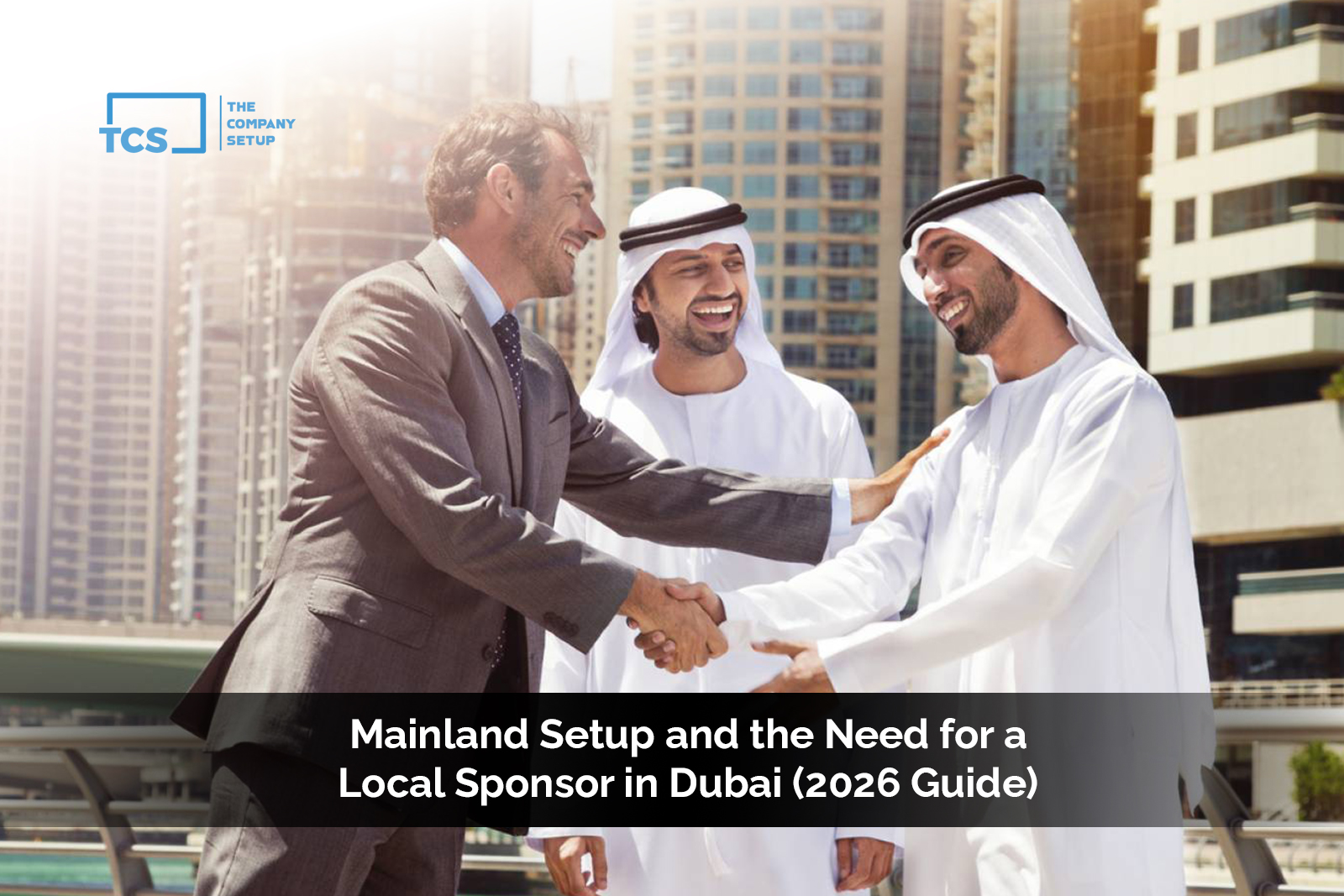
A local sponsor in Dubai is usually either a UAE national (an Emirati individual) or a company that is fully owned by UAE nationals. Their involvement is tied to how certain Mainland businesses are licensed and structured.
In older models, a Mainland LLC required a UAE national shareholder holding 51% shares, while the foreign investor held 49%. That structure created fear among many investors, because “51%” sounds like majority control.
But here’s the nuance most people miss: shareholding and control are not always the same thing in practical terms, especially when proper agreements exist. In many traditional sponsorship setups, the sponsor was a legal requirement rather than an operational partner. The foreign investor ran the business, made decisions, controlled revenue, and managed the day-to-day, while the sponsor’s involvement was mainly administrative.
Still, it’s important to say this clearly: any structure involving sponsorship must be handled carefully. If it is done casually, without strong agreements, then yes, there is risk. But with proper documentation, sponsorship can be structured to protect the investor’s business interests and clarify roles from day one.
Do You Still Need a Local Sponsor in Dubai in 2026?
The short answer is: sometimes yes, sometimes no.
Dubai has introduced significant reforms that allow 100% foreign ownership for many commercial and industrial activities. That means many business owners no longer “need a local sponsor in Dubai” in the traditional 51/49 sense. If your activity falls under the eligible list and your licensing pathway supports it, you can own the company fully.
However, there are still cases where local participation remains required. This is usually for specific categories of activities that are regulated more tightly, sensitive, or considered strategically important. Additionally, professional license structures often require a Local Service Agent (LSA), which is different from a shareholder sponsor.
So the real decision framework becomes:
- What business activity are you licensing?
- What exact license type are you applying for?
- Does your activity allow 100% ownership or require a sponsor/agent?
Once you answer these three questions, the sponsor requirement becomes clear.
Three Common Sponsorship Structures in Dubai Mainland
People use the word “sponsor” loosely, but in reality, there are different models. Understanding them prevents confusion.
1) Local Sponsor as Shareholder (Traditional Model)
This is the older model where the UAE sponsor holds shares (historically 51%). In modern practice, the relationship is often structured as a nominee arrangement with side agreements that clarify economic and management control for the investor.
2) Corporate Sponsor (A UAE-Owned Company)
Instead of an individual sponsor, a UAE-owned corporate entity becomes the local sponsor. Many investors prefer this option because it feels more structured and stable compared to relying on one person.
3) Local Service Agent (LSA) for Professional Licenses
A Local Service Agent does not hold shares and does not own part of the business. Their role is to represent the business in front of government departments for administrative matters. This is common for professional activities such as consulting and skilled services.
When a Sponsor Is Mandatory vs When It’s Optional
A sponsor is mandatory when:
- The activity is regulated in a way that requires local participation
- The licensing authority specifies local shareholder involvement
- The business activity falls into a category with restrictions
A sponsor can be optional (strategic) when:
- You qualify for 100% ownership, but you choose a local partnership for market leverage
- You want stronger local positioning and relationship-driven credibility
- You are planning government tenders and want easier navigation
A sponsor is not required when:
- Your activity allows 100% ownership, and your setup is structured accordingly
- You are in a Free Zone (different model)
- You are under a professional license with LSA instead of sponsor ownership
The key message for readers is: don’t assume & verify the activity and structure first. This is exactly where many people make mistakes.
Why Some Businesses Still Choose a Local Sponsor for Business in Dubai
Even in 2026, you’ll still find entrepreneurs who can legally own 100% but still choose a local sponsor for business in Dubai. That decision is usually not emotional; it’s commercial.
Dubai is a relationship-driven market. Local trust, local credibility, and fast process navigation can matter in practice, especially for businesses that interact frequently with local stakeholders. A sponsor with the right structure can sometimes make things feel smoother in terms of administration, local credibility, and relationship-building.
That said, it’s important to be clear with your audience: choosing sponsorship as a “strategic advantage” only works when the sponsor relationship is professional, transparent, and contractually safe. Otherwise, the “advantage” becomes a liability.
Understanding Local Sponsor Fees in Dubai
Now let’s address what your readers will search directly: local sponsor fees in Dubai.
Sponsor fees are not a fixed “government price tag.” In most cases, sponsorship involves a private agreement between the business owner and the sponsor. The sponsor may receive an annual service fee or a fixed remuneration amount.
What affects local sponsor fees in Dubai?
- The type of sponsor (individual vs corporate)
- The complexity of the business activity
- Whether additional support is expected beyond paperwork
- The reputation and professionalism of the sponsor arrangement
- Whether the sponsor is simply a legal requirement or part of broader advisory support
Most modern sponsorship models are structured as fixed annual fees rather than profit-sharing, because investors prefer clarity and sponsors often prefer predictable compensation. The most important part isn’t the number; it’s the agreement: what exactly is included, what rights exist, and how changes or exits are handled.
The Legal Safety Layer: Agreements That Protect Investors
If you’re using a sponsor structure, protection comes from documentation. This is where the conversation becomes serious: sloppy documentation creates risk, not the sponsor concept itself.
Common documents involved include:
- MOA (Memorandum of Association): Defines shareholding and basic company structure.
- Side Agreement: Clarifies profit rights, management control, and sponsor limitations.
- Power of Attorney (if applicable): Grants authority for operational decisions under defined boundaries.
- Exit and Transfer Clauses: Defines how you can change sponsors or restructure later.
A professional sponsorship setup should never feel “handshake-based.” It should feel like a clean business contract where everyone understands their role. This is the difference between safe sponsorship and risky sponsorship.
Myths That Confuse Investors About Sponsorship
Let’s clear up the myths that keep repeating:
Myth 1: If the sponsor has 51%, they own your business.
Not necessarily. Ownership on paper can be separated from economic benefit and management authority through properly structured agreements. But you must do it professionally.
Myth 2: Sponsorship always means profit sharing.
Modern sponsorship models often use fixed annual fees instead of a profit share. Profit share is not the default.
Myth 3: You always need a sponsor for the Mainland.
Not true in 2026. Many activities allow 100% foreign ownership.
Myth 4: Any sponsor is fine.
No. Sponsor quality matters. Structure matters. Documentation matters.
How to Choose the Right Local Sponsor in Dubai
Choosing a sponsor should feel like hiring a critical long-term partner, not like selecting a random name to “finish the license.”
Good sponsor selection includes basic due diligence:
- Is the sponsor arrangement transparent about fees and obligations?
- Will you sign clear agreements that protect you?
- Is the sponsor experienced in your business category?
- Is the sponsor reachable and accountable if anything is needed?
- Is the structure stable (especially if a corporate sponsor)?
Many investors lean toward corporate sponsorship because it feels more consistent and less dependent on individual circumstances. But the right choice depends on your business model and your risk comfort.
What If You Don’t Want Sponsorship At All?
If you don’t want a sponsor, your best path is to choose an activity and structure that qualifies for 100% foreign ownership, and then set up accordingly. That requires correct activity selection, correct licensing pathway, and correct documentation.
This is where many entrepreneurs make an avoidable mistake: they pick an activity based on what sounds nice, not based on what structurally fits their ownership preference and business needs. Later, they discover the activity classification triggers requirements they didn’t plan for.
So the smarter approach is to decide:
- What are you selling or offering?
- What activities match that commercially?
- Which activity codes best support your ownership and growth goals?
Practical Example Scenarios
Let’s make it easier for you by mapping realistic scenarios.
If you are opening a consulting business, you may not need a shareholder sponsor, but you might need a Local Service Agent for government interactions. That means you keep ownership, but you still appoint a local agent for administrative liaison.
If you are planning a Mainland trading operation and your activity classification requires sponsorship, you may need a local sponsor structure, ideally with strong agreements that protect your operational control and profit rights.
If you qualify for 100% ownership under your chosen activity, then you can structure it without requiring sponsorship, and the “need a local sponsor in Dubai” question becomes irrelevant for your case.
Conclusion: Sponsorship in 2026 Is About Structure, Not Fear
The sponsorship story in Dubai has matured. It’s no longer a simple rule where every Mainland company must have a sponsor. Instead, it’s a structured decision that depends on activity, license type, and business goals.
If your business activity requires it, then a sponsor setup must be handled professionally with clear documentation and a clean agreement model. If your business activity doesn’t require it, then you can choose a 100% ownership route and move forward with full control.
Either way, the smartest investors don’t guess. They verify the activity, confirm the structure, and build the company the right way from day one.
Because in Dubai, the business opportunities are huge, but the best results come when your setup is built on clarity, not assumptions.
FAQ
Do I need a local sponsor in Dubai for the Mainland in 2026?
Not always. It depends on your business activity and license type. Many activities allow 100% foreign ownership.
What is a local sponsor in Dubai?
A UAE national or UAE-owned company is often involved in certain Mainland structures, often as a legal requirement.
What are local sponsor fees in Dubai?
Usually, a privately agreed annual service fee, depending on sponsor type, activity complexity, and agreement scope.
Is a local sponsor for business in Dubai the same as a Local Service Agent?
No. A Local Service Agent doesn’t hold shares and typically supports professional licenses as a government liaison.Disclaimer:The information provided in this article is for general informational purposes only and does not constitute legal, financial, or professional advice. While we strive to keep the information up-to-date and correct according to 2026 UAE regulations, laws regarding business ownership, corporate tax, and licensing are subject to frequent changes by the Department of Economy and Tourism (DET) and other federal authorities. Readers are strongly encouraged to consult with a licensed legal consultant or a professional business setup firm before making any financial or legal commitments.